SayStrike: turning pronunciation practice into a game
· buildtolaunch
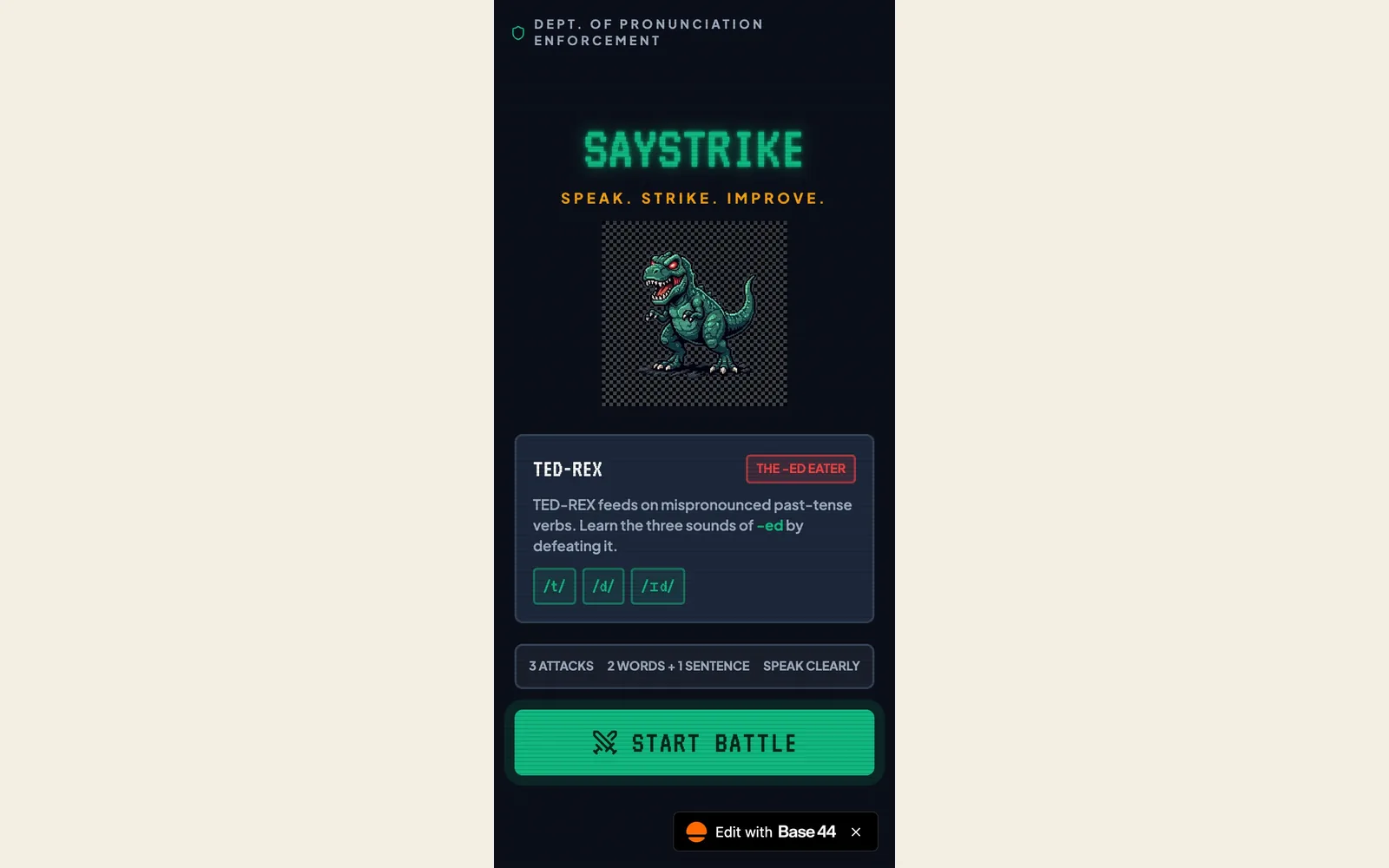
SayStrike is a speaking game where saying a word correctly is how you win, and a student built it in one afternoon. This guide covers what the app does, the idea behind it, and how you can build a pronunciation game of your own, even if you do not code. Part of the student project library (in Vietnamese).
Short answer
SayStrike is a web app by Bernie, a participant at Vibe-a-thon Saigon. You speak English past-tense verbs, and a correct pronunciation attacks TED-REX, a monster that eats verbs said wrongly. It won the "Learning a language" track and is hosted on Base44. You can build a similar game by describing the rules to an AI builder in plain language.
What SayStrike does
SayStrike by Bernie, built in one afternoon at Vibe-a-thon Saigon.
Most language apps are good at vocabulary. They are less good at telling you that you keep saying a word wrong. SayStrike picks one narrow, common problem, the ending of regular past-tense verbs, and turns practice into a game loop: say the word, hit the monster, repeat.
You can open SayStrike here. It was built at Vibe-a-thon Saigon (Sunday 27 September 2026, at WORK X), where the brief was to start from something you already use and build what you wish it did. The day is covered in the Vibe-a-thon Saigon recap.
Why the -ed ending is a good game problem
The written ending -ed has three spoken forms in English:
- /t/ after many unvoiced sounds: walked, helped, watched.
- /d/ after many voiced sounds: played, cleaned, called.
- /ɪd/ after words ending in a t or d sound: wanted, needed, decided.
Learners often say every -ed the same way, and nobody corrects them for years. That makes it a good target for an app: the rule is small, the right answer is clear, and a learner gets feedback in seconds. The same shape fits other small, repeatable problems, such as word stress or the sounds of "th".
Why a game works for practice
A game gives a reason to repeat the same skill many times. In SayStrike, the loop is short: a verb appears, you say it, and the result is visible (the monster takes a hit or eats the word). You can copy that structure for any drill.
- One clear action. Speak one word.
- Instant result. Hit or miss, no long explanation first.
- A visible stake. A monster, a score or a streak.
- A reason to come back. A new set of words or a harder level.
If you want a ready-made way to practise your own skills on buildtolaunch, the AI tutor works like a conversation drill. For more ideas in this area, see the app ideas for learning English (in Vietnamese).
Build a pronunciation game yourself
This is a walkthrough for building an app of the same kind, not a record of Bernie's own steps. Base44, the tool used at the event, and other AI builders such as Lovable have free plans with limits. Check each tool's pricing page before you start, because credits and limits change.
Step 1: Pick one sound problem you know well
Choose a problem you have felt yourself. Past-tense endings, the "ship" and "sheep" vowels, or the final consonants that are easy to drop. One problem is enough for a first version.
Step 2: Write the smallest game
Skip levels, accounts and leaderboards. A first version needs a list of words, a button to speak, a check, and a result. If speech recognition is hard in your builder, start with a multiple-choice version where the player picks how the ending sounds, then add speaking later. Ask the AI builder what it can support.
Step 3: Write one clear prompt
Paste something like this and edit it for your problem:
Build a web game that helps me practise the pronunciation of regular past-tense verbs in English. Show a verb in the past tense (for example "walked"). The player says the word into the microphone. If it is correct, show an attack animation on a monster; if not, the monster eats the word and the player sees the correct ending (/t/, /d/ or /ɪd/). Keep a score and a streak. Use 20 verbs. Mobile first, playful style, interface in English.
Add a line for "done": "It is finished when I can play 10 words in a row and see my score."
Step 4: Test with real learners
Ask three friends who study English to play for five minutes each. Watch where they hesitate. If the app marks a correct word as wrong, fix that first, because a game that is unfair is not fun.
Step 5: Share the link
Post the link where learners are, for example a class chat, and ask one question: "What was the first thing that confused you?" Then post it publicly on the Launch League so other builders can try it.
Mistakes to avoid
- Teaching the whole language. One sound, one game.
- Trusting the first version's scoring. Test it with different voices and accents, and say so in the app if it can be wrong.
- Making the monster the main thing. The theme is decoration; the practice is the point.
More student builds
For another small app from the same event, see how a student built Segue. For apps that use the webcam, see YellowMiso and Smile Andy. To get a first prompt ready, browse the starter prompt library.
Build yours with buildtolaunch
buildtolaunch is a free community for university students in Vietnam and Southeast Asia, with no paid tier and no coding needed to start. You can learn from 70+ free courses, practise with an AI tutor, build in a Space with an AI teammate, and post your launch on a public board that resets every Monday. Create a free profile.
Read the full guide: student project library.
FAQ
Who built SayStrike?
SayStrike was built by Bernie at Vibe-a-thon Saigon, a build day run by buildtolaunch in Saigon on Sunday 27 September 2026. It won the "Learning a language" track. The app is live at saystrike.base44.app.
What does SayStrike do?
It is a speaking game for English learners. You say past-tense verbs aloud, and correct pronunciation attacks TED-REX, a monster that eats verbs said wrongly. It focuses on one common problem, the sound of the -ed ending.
What tool was SayStrike built with?
The app is hosted on Base44, the build tool used at the event. Base44 lets you describe an app in plain language and builds it for you. The details of Bernie's own prompts and process are not covered in this article.
Can I build a pronunciation app without coding?
Yes. AI builders write the code from your description. Start with a very small version: a short word list, one speaking or multiple-choice step, and a clear result. Many people at Vibe-a-thon Saigon had no coding background and still shipped working apps in one afternoon.
How accurate can a pronunciation game be?
Treat any simple app as a practice aid, not a judge. Speech recognition can be wrong with different voices, accents or background noise, so test with several people and tell players that results are approximate. For serious exam preparation, practise with a teacher too.
How long does it take to build a game like this?
The first version can fit in an afternoon, as it did at Vibe-a-thon Saigon. A game with accounts, many levels or reliable speech scoring takes longer, often a weekend or more. Keep the first version small and improve it after real players try it.